
 Pin it
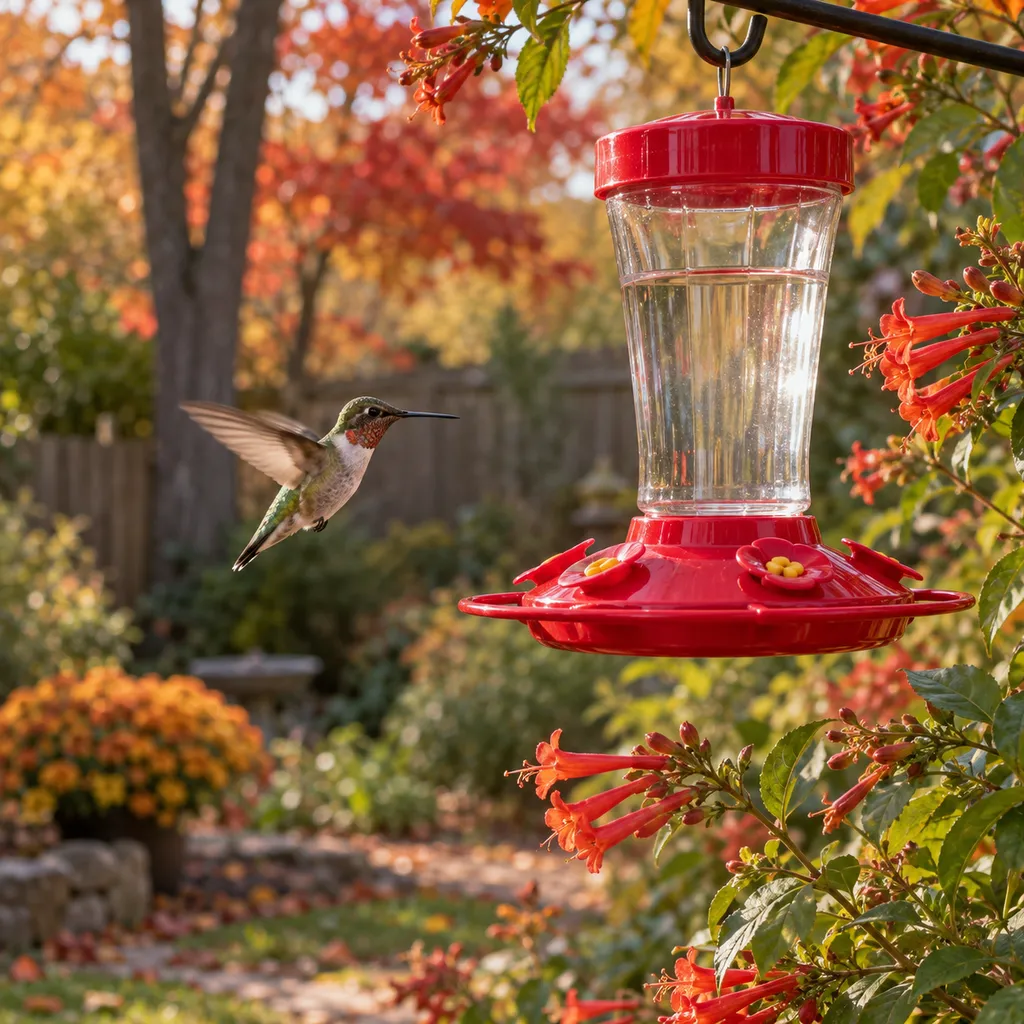
No, feeders do not stop hummingbirds from migrating. Keeping a hummingbird feeder up in fall will not make the birds forget to leave, stay too long, or miss their normal journey. The Cornell Lab explains that changing day length is a major migration cue, and that hummingbirds migrate whether feeders are present or not (All About Birds). A feeder is better understood as a fuel stop, not a trap. The useful decision for a backyard feeder owner is not whether to remove nectar to push birds south; it is whether the feeder is clean, filled with fresh 4:1 nectar, and available long enough for late migrants that may pass through after your resident birds have already gone.
The Short Answer: Leave the Feeder Up If You Can Maintain It
If your feeder is clean and the nectar is fresh, leaving it up in fall is generally helpful. It gives local birds, young birds, and migrants from farther north a reliable sip during a season when natural flower bloom can be changing quickly. Cornell’s All About Birds says there is no reason to take feeders down to encourage migration; feeders do not influence whether a bird starts its journey south (All About Birds). Smithsonian’s National Zoo gives the same practical answer: clean feeders left up longer than the usual dates do no harm and may help stragglers, while hummingbirds rely on an internal seasonal clock tied to day length (Smithsonian National Zoo).
That answer comes with one important condition: a neglected feeder is not a kindness. In fall, warm afternoons can still spoil nectar, and a feeder that sits cloudy or dirty is not useful. If you are traveling, too busy to refill, or unable to clean it at every refill, it is better to take it down, wash it, and store it than to leave stale sugar water outside. But if you can keep up with basic care, you do not need to remove the feeder just because the calendar says September or October.
What Actually Tells Hummingbirds to Leave
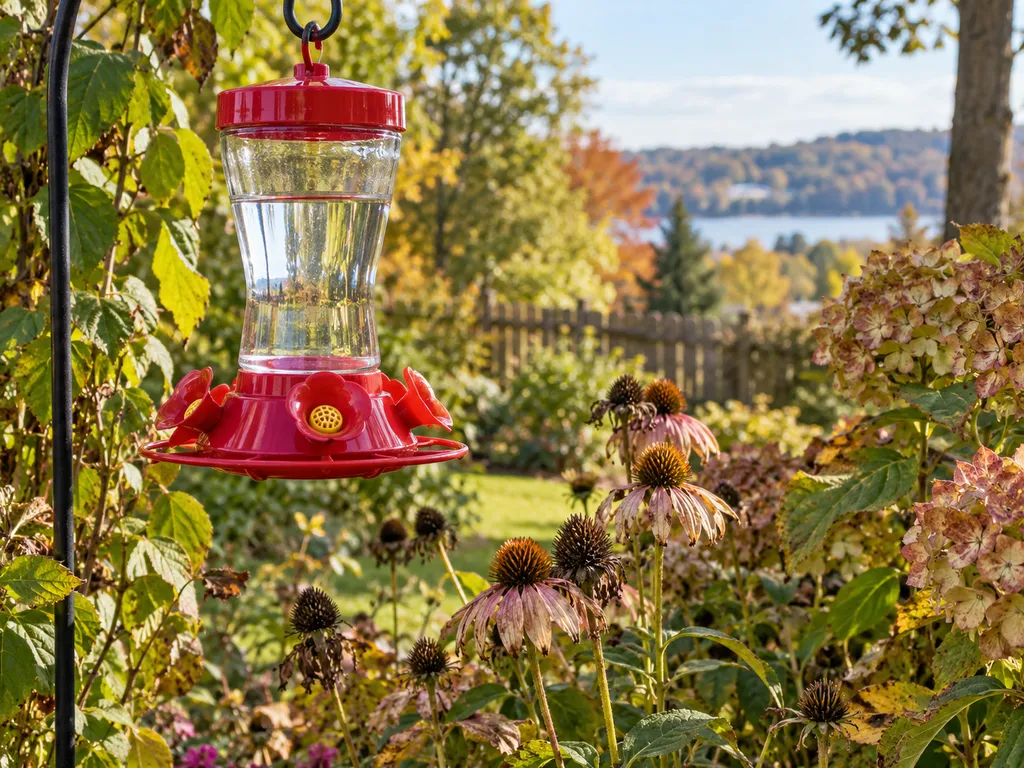
Migration is not switched on by an empty yard. Hummingbirds respond to seasonal cues that are much bigger than one feeder: especially changing day length, along with inherited timing, weather, and the availability of natural food along the route. Cornell notes that as late-summer days shorten, birds become restless and start moving even where feeders remain available (All About Birds). That is why one yard can still have a feeder and lose its regular birds anyway. They are not being rude; they are following an older schedule than any backyard routine.
Feeder traffic often makes this confusing. A yard may feel busy in August, quieter the next week, lively again when a wave of migrants passes through, and empty soon after. Adult males often leave first, followed later by females and young birds; Cornell describes this general pattern in explaining why feeder numbers can fall and rise through late summer and fall (All About Birds). The birds you see in September may not be the same individuals you watched in June. Some are simply using your feeder as a stopover on the way through.
Why a Fall Feeder Can Help Rather Than Hold Them Back
A hummingbird feeder is a small, predictable energy source. It does not replace migration habitat, flowers, insects, or resting cover, but it can help a bird top up quickly. The National Park Service describes feeders as giving hummingbirds a quick burst of energy without drawing them away from natural foods (National Park Service). Audubon likewise says backyard feeders can be especially useful during spring and fall migration when kept clean and filled properly (Audubon).
Think of a fall feeder as one piece of a larger stopover. The best backyard support combines a clean feeder with cover, perches, flowers, and a yard that still supports tiny insects and spiders. Hummingbirds do not live on sugar water alone; they also catch small insects and spiders for protein, especially when feeding young, a point Audubon and Smithsonian both emphasize (Audubon; Smithsonian National Zoo). In fall, that means a feeder is helpful, but it is not the whole habitat.
- Keep using the standard 4:1 ratio: 1 part plain white table sugar to 4 parts water.
- Do not add red dye, honey, artificial sweeteners, juice, brown sugar, raw sugar, or additives.
- Put the feeder where you can clean and refill it easily, because maintenance matters more than the exact week on the calendar.
- Let flowers, shrubs, and natural perches do part of the work; the feeder is only one resource.
How Long Should You Keep a Feeder Up in Fall?
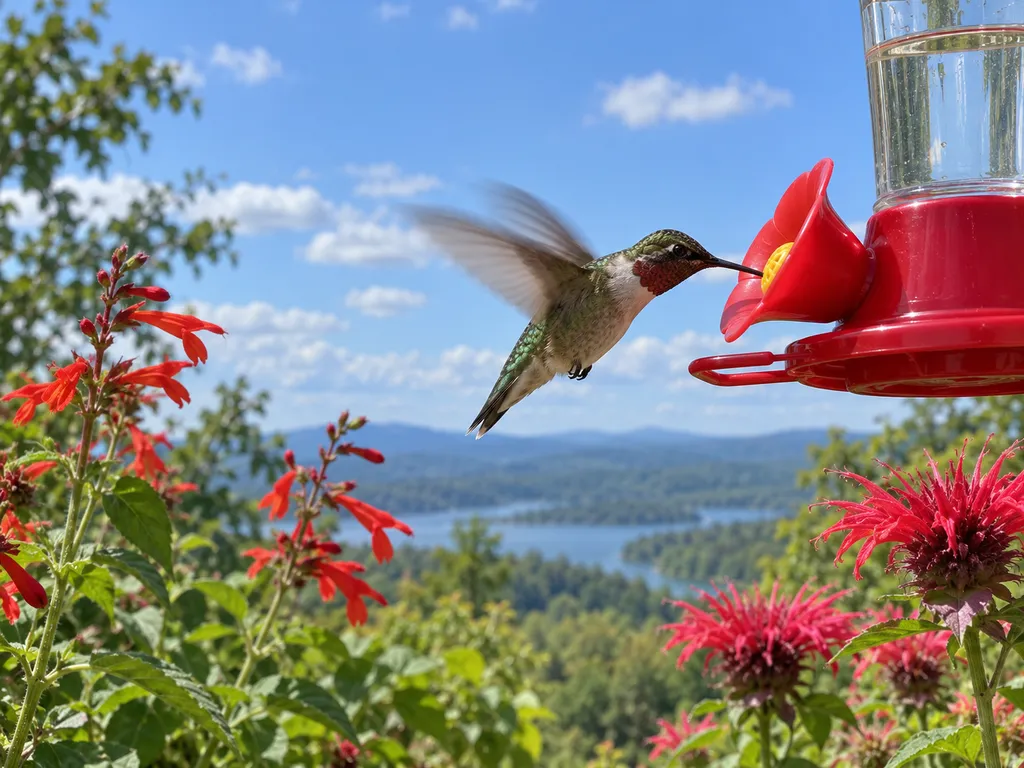
A practical rule is to keep the feeder available for about two weeks after your last confirmed hummingbird sighting. Audubon recommends keeping feeders up for two weeks after the last bird uses them in fall (Audubon). This simple rule works because it gives late migrants a chance to refuel without asking you to guess the exact end of migration. It also avoids the common mistake of taking feeders down the first day your regular birds disappear, even though migrants from farther north may still be on the move.
The calendar should be flexible. Smithsonian gives broad regional timing rather than exact dates: southern and Gulf Coast areas may have a much longer feeder season than northern areas, and places with year-round hummingbirds do not need a winter shutdown at all (Smithsonian National Zoo). The National Park Service also notes that arrival timing varies by region, with earlier activity in southern areas and later arrival farther north (National Park Service). That is why a rigid national date is less useful than local sightings plus the two-week rule.
What If a Hummingbird Is Still Visiting Very Late?
A late hummingbird does not automatically mean your feeder caused a problem. Some birds migrate later than others, some juveniles linger, and occasional out-of-range birds appear in fall or early winter. The National Wildlife Federation advises leaving sugar-water feeders out as local birds depart because migrants from farther north may pass through and recharge at feeders (National Wildlife Federation). If a hummingbird continues to visit, the most helpful response is steady maintenance: keep the feeder clean, use clear 4:1 nectar, and avoid changing the nectar strength to “help” migration. The standard ratio remains the rule.
In areas with freezing nights, the question shifts from migration to winter feeder care. A feeder that freezes solid is not useful, and a feeder that warms during the day still needs regular cleaning. If you choose to keep feeding a late bird through cold weather, be realistic about the daily work. Rotate feeders, protect them from freezing where appropriate, and take them down if you cannot keep them clean and liquid. Do not try to hand-feed, capture, keep, or move a hummingbird. If a bird appears injured or unable to fly, the right path is to contact a licensed wildlife rehabilitator through your state wildlife agency.
Keep the Feeder Useful: Fresh Nectar and Simple Care
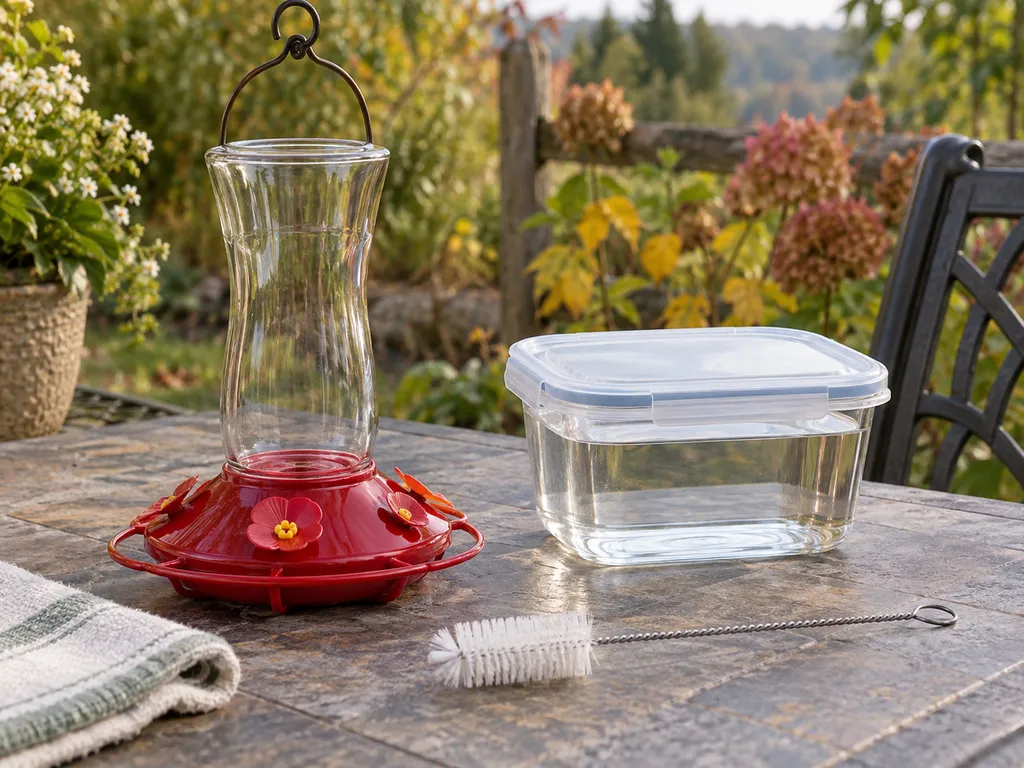
The feeder only helps if the nectar stays fresh. Use clear nectar made at the 4:1 ratio: 1 part plain white table sugar to 4 parts water. Boiling is optional; it can help dissolve sugar, but the nectar must cool before filling. Store extra nectar in a clean, covered container in the refrigerator for up to about a week. Smithsonian recommends refined white sugar and water, no red dye, and regular cleaning and refilling (Smithsonian National Zoo). The red parts of the feeder are enough to attract birds; the liquid should look clear, like water.
In warm weather, change nectar often. A good working schedule is every 1 to 2 days above 90°F, every 2 to 3 days in the 80s°F, and every 4 to 6 days in cooler weather. Replace it sooner if it looks cloudy, stringy, or speckled, or if the feeder has been sitting in full sun. Clean the feeder at every refill with hot water and a bottle brush, and clean ports with a small brush or pipe cleaner. Audubon recommends frequent cleaning and immediate cleaning when nectar looks cloudy (Audubon).
Placement matters too. Partial shade slows spoilage. Nearby shrubs or trees provide perches, but avoid placing the feeder where a predator can easily hide and launch. If the feeder is near a window, put it directly on the window or within about 3 feet, or place it farther than about 30 feet away, which are commonly recommended collision-reduction distances. Multiple small feeders spaced out of sight of one another can also reduce guarding by one dominant bird, a setup Audubon recommends for yards with territorial hummingbirds (Audubon).
What Feeder Traffic Can and Cannot Tell You
A quiet feeder is not proof that you did something wrong. Natural flower bloom, nearby feeders, territorial behavior, nesting stages, weather, and migration waves all change how often birds visit. Cornell points out that feeder activity in one yard does not necessarily reflect a whole population trend, and that natural food availability can reduce feeder visits (All About Birds). In other words, “no birds today” can mean “they found better flowers,” “a dominant bird is guarding another spot,” or simply “migration has moved on.”
That uncertainty is why the best fall plan is steady and simple: keep the feeder clean while birds are around, leave it up for about two weeks after the last sighting, and then store it clean and dry until the next season. Do not use an empty feeder as a migration signal. Do not strengthen the nectar for fall. Do not add dye or extras. The feeder’s job is modest but valuable: offer a clean, clear, quick source of sugar water to birds that already know when it is time to travel.
The Bottom Line
Hummingbird feeders do not stop migration. Shortening day length and other seasonal cues send hummingbirds on their way, even when feeders are still available. A clean fall feeder can help late migrants refuel, so the most practical rule is to keep feeding until roughly two weeks after your last sighting, then clean and store the feeder if no birds remain.
Frequently Asked Questions
Will taking my feeder down make hummingbirds migrate sooner?
No. Removing a feeder is not needed to start migration. Hummingbirds respond mainly to seasonal cues such as shortening day length, so a clean feeder left up in fall does not keep them from leaving.
Can I leave a hummingbird feeder up all winter?
Only if hummingbirds occur in your area and you can maintain the feeder properly. In year-round hummingbird areas, winter feeding can be normal. In colder areas, keep feeding only if you can keep nectar liquid, fresh, and the feeder clean.
How long after my last hummingbird should I wait?
A common rule is about two weeks after the last sighting. That gives late migrants a chance to find the feeder while avoiding a dirty feeder sitting outside long after activity has ended.
Should I make stronger nectar for fall migration?
No. Keep the standard 4:1 ratio: 1 part plain white table sugar to 4 parts water. Stronger mixes are not recommended as a routine migration or winter adjustment.
Why did hummingbirds vanish even though my feeder is full?
They may have migrated, shifted to natural flowers, moved to a neighbor’s feeder, or been pushed away by a territorial bird. A full feeder does not guarantee visits, and a quiet feeder does not automatically mean the birds are in trouble.
Sources
This guide was researched using these sources.
- https://www.allaboutbirds.org/news/should-i-stop-feeding-birds-in-fall-so-they-can-start-their-migration
- https://www.allaboutbirds.org/news/youre-seeing-fewer-hummingbirds-at-your-feeder-should-you-worry
- https://www.audubon.org/community-science/hummingbirds/how-create-hummingbird-friendly-yard
- https://www.fws.gov/sites/default/files/documents/FW-2002-For-The-Birds-Booklet.pdf
- https://www.nps.gov/articles/hummingbirds.htm
- https://nationalzoo.si.edu/migratory-birds/hummingbird-nectar-recipe
- https://nationalzoo.si.edu/migratory-birds/hummingbirds
- https://www.nwf.org/Magazines/National-Wildlife/2010/Attract-Fall-Birds