
 Pin it
The best hummingbird feeder type is usually a small, easy-to-clean saucer or bottle feeder with red parts, clear nectar, tight seams and ports you can scrub. Saucer feeders are often simpler and less likely to leak; inverted bottle feeders are familiar and visible but need careful placement and assembly. Glass looks durable and resists staining, while plastic can be lighter and easier to hang. The right choice is less about decoration and more about cleaning access, capacity, leak control, pest control and safe placement.
The Two Big Feeder Shapes: Saucer and Inverted Bottle
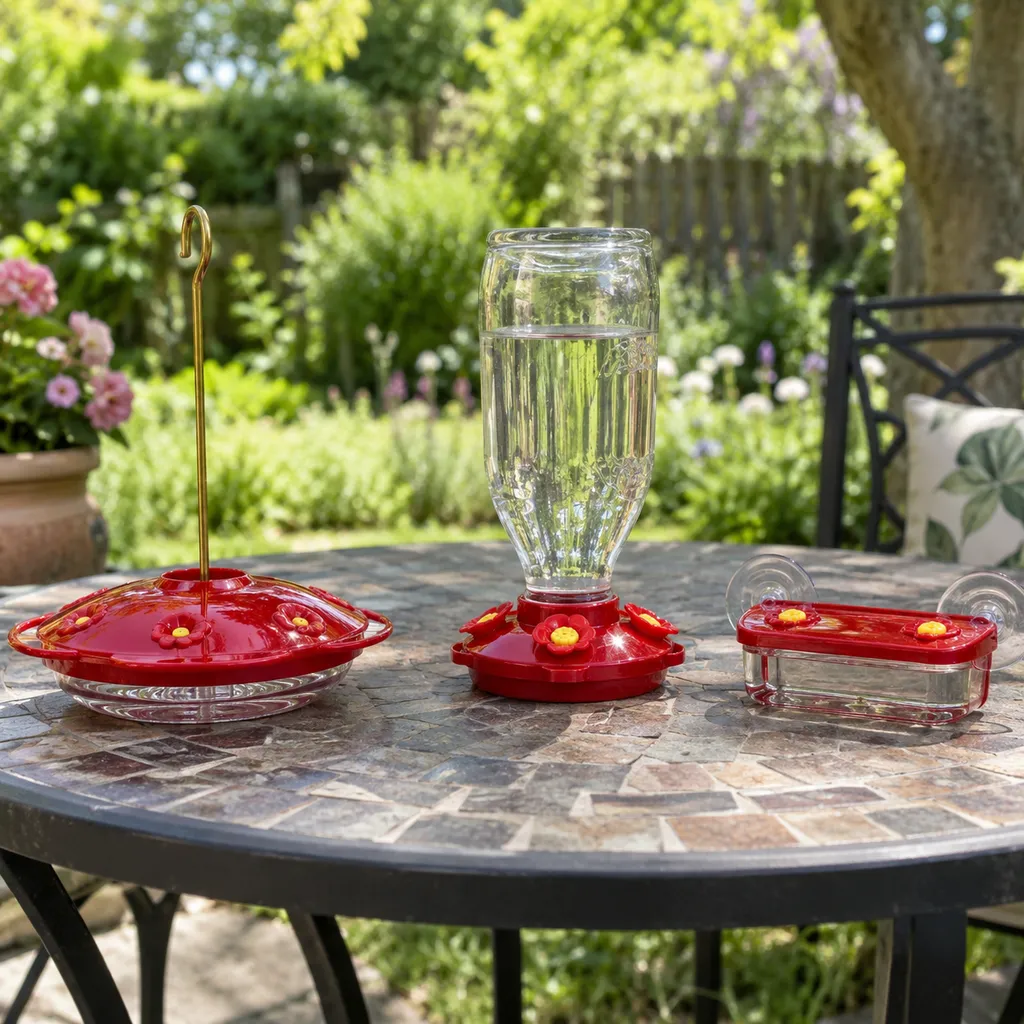
Most hummingbird feeders fall into two broad shapes. A saucer feeder, sometimes called a dish or tray feeder, is a low reservoir with feeding ports on top. An inverted bottle feeder suspends the nectar above the base, allowing liquid to feed down into ports below. Cornell Lab’s All About Birds notes that bottle or tube feeders may be glass or plastic and commonly use red plastic flowers or bee guards at the ports, while plastic saucer-style feeders place ports on top and may include a small water moat for ants https://www.allaboutbirds.org/news/feeding-hummingbirds/.
That difference matters in daily use. A saucer feeder keeps the nectar below the port openings, so insects have a harder time reaching it and gravity is less likely to push liquid out. A bottle feeder can work very well, but it depends more on a good seal, a level hanger and shade. All About Birds specifically warns that bottle feeders tend to leak in sun because warming air in the top of the bottle expands and pushes nectar out; tray feeders do not have that same pressure problem https://www.allaboutbirds.org/news/feeding-hummingbirds/.
Saucer Feeders: Simple, Low and Often Practical
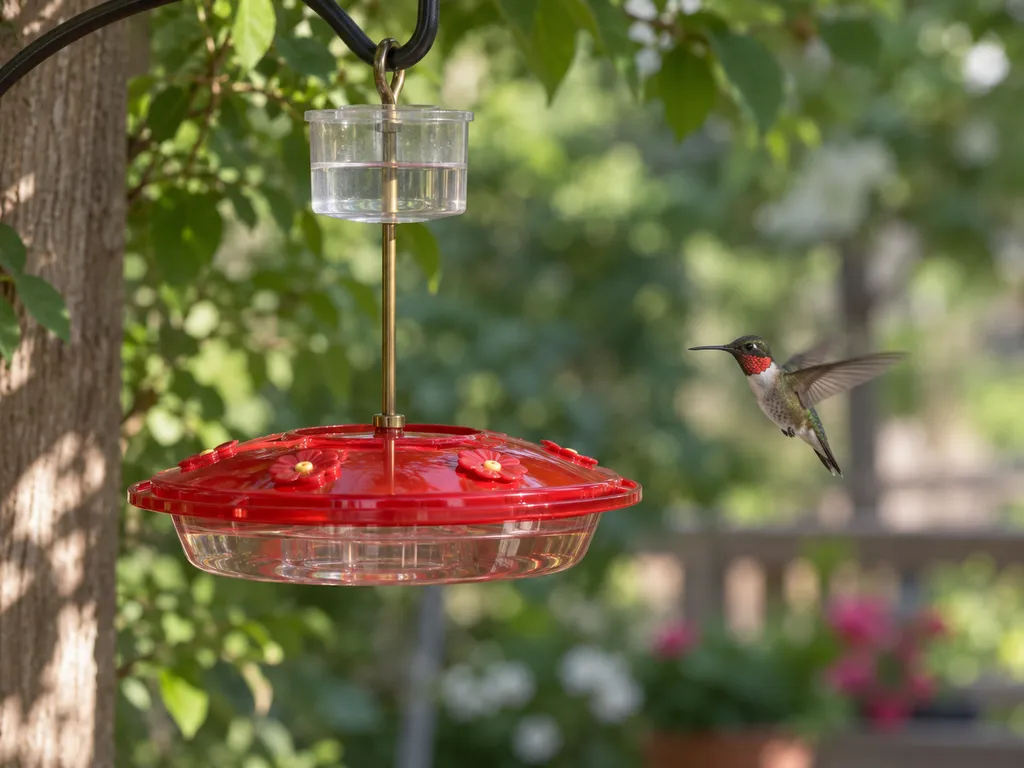
A saucer feeder is a strong first choice for many backyards because the design is shallow, stable and usually quick to disassemble. The top lifts off, the reservoir is wide enough to reach, and the ports can be brushed without forcing a tool through a narrow bottle neck. That ease matters because sugar water needs frequent replacement. Audubon advises cleaning hummingbird feeders every two to three days, or daily in particularly hot conditions, and immediately whenever nectar turns cloudy https://www.audubon.org/community-science/hummingbirds/how-create-hummingbird-friendly-yard.
Saucer feeders are also a sensible choice when bees, wasps or ants are a recurring issue. Because the nectar level is below the ports, many insects cannot reach it as easily. If the feeder includes a central ant moat, keep that moat filled with plain water. Do not add oil, grease, sticky barriers or insecticides on or near a hummingbird feeder; a clean water barrier and a non-leaking feeder are the safer approach. Audubon’s pest guidance emphasizes tidy feeders, secure assembly, wiping spills and ant moats or bee guards rather than chemical fixes https://www.audubon.org/magazine/how-keep-your-hummingbird-feeder-free-pests.
Inverted Bottle Feeders: Visible, Familiar and Worth Choosing Carefully
Inverted bottle feeders remain popular because they show the nectar level clearly and often look like the classic red-and-clear hummingbird feeder. They can be glass or plastic, with a reservoir above a red base. Choose one with a wide mouth, a base that separates fully, and ports that can be scrubbed with a small brush. A narrow decorative bottle may look attractive but become frustrating if residue collects where no brush can reach.
The main tradeoff is leak control. Bottle feeders rely on a vacuum and tight connections. If the base is cross-threaded, the gasket is worn, the hanger swings in wind, or direct sun heats the trapped air, nectar can drip. Leaks waste nectar and attract insects. Cornell’s placement advice is to put hummingbird feeders where they are protected from wind and mostly shaded, because swaying can spill sugar solution and sun speeds spoilage https://www.allaboutbirds.org/news/where-to-put-your-bird-feeder/.
Glass vs Plastic: Material Is Secondary to Cleaning Access
Glass and plastic can both work. Glass reservoirs resist scratching and staining, feel stable in the hand and are often paired with replaceable bases. Their downsides are weight and breakage risk. Plastic feeders are lighter, less fragile and common in saucer designs, but low-quality plastic can warp, cloud, crack or scratch over time. Scratches and tight seams can hold residue, so a plastic feeder should be replaced when it no longer cleans smoothly.
Do not treat glass as automatically better or plastic as automatically worse. The better question is whether the feeder comes apart completely and lets you clean every surface. Project FeederWatch recommends taking hummingbird feeders apart, washing thoroughly with warm water and dish soap, rinsing thoroughly, and cleaning them more often than seed or suet feeders because mold and fungi readily grow in sugar water, especially in warm temperatures https://feederwatch.org/learn/feeding-birds/how-to-clean-your-feeders/.
- Choose glass if you want a heavier reservoir, clear visibility and a material that resists staining when handled carefully.
- Choose plastic if you want a lightweight saucer feeder, a window feeder, or a low-cost model you can replace when parts wear out.
- Avoid either material if the feeder has hidden cavities, glued-on decorations around ports, or a reservoir neck too narrow for a brush.
Window Feeders: Close Views With Placement Rules
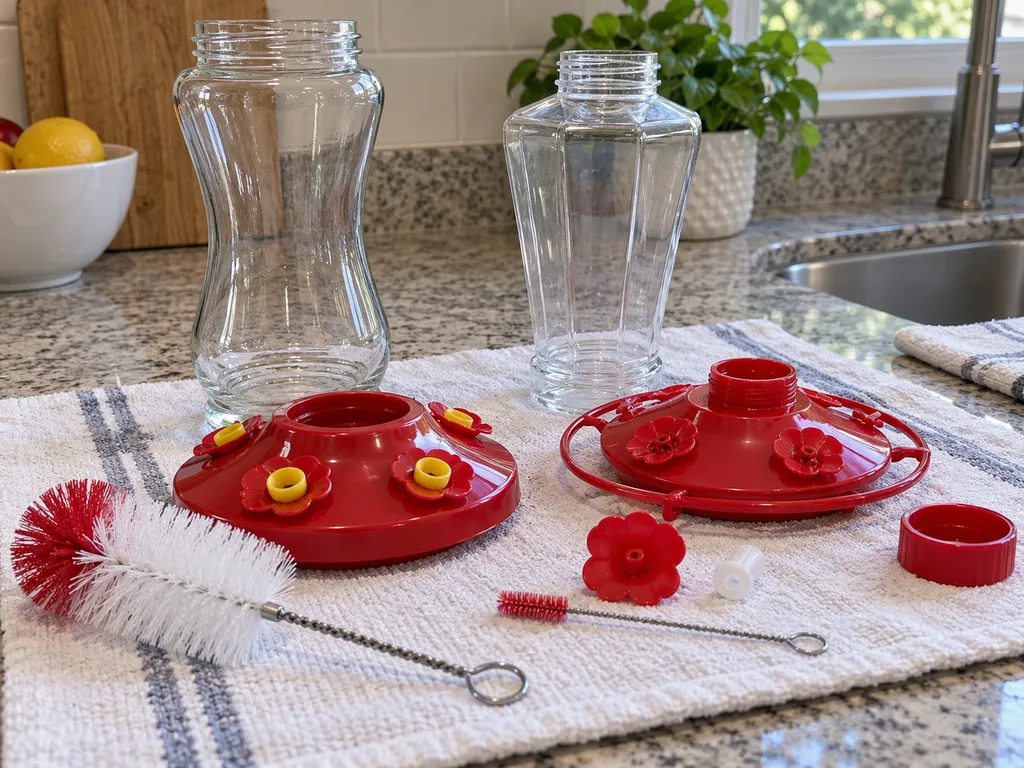
Window hummingbird feeders attach directly to glass with suction cups. Most are small saucer-style feeders, which is a good match because a window feeder needs to be light, stable and easy to remove for cleaning. The appeal is obvious: you can watch a hummingbird at close range without moving around the yard. The responsibility is just as important: keep suction cups clean, check them often, and do not let a neglected feeder sit against a sunny pane.
Window placement is not automatically unsafe. Cornell Lab’s general feeder-placement guidance says feeders are safest either very close to a window, including attached to the glass or frame, because birds cannot build much speed if startled, or placed away from windows; it specifically recommends closer than 3 feet for a picture window and notes that hummingbird feeders should also be protected from wind and mostly shaded https://www.allaboutbirds.org/news/where-to-put-your-bird-feeder/. If your window reflects trees or sky strongly, add bird-safe external window treatments as a separate collision-reduction step.
Handheld Feeders: A Specialty Tool, Not a Starter Feeder
Handheld hummingbird feeders are tiny cups or tubes meant for supervised close viewing. They are not a replacement for a regular hanging feeder, and they are not a good way to start feeding. They require patience, stillness and careful cleaning after each use. They also create a human-centered feeding situation, so use them only briefly and never try to touch, catch or restrain a hummingbird. For most households, a small hanging saucer feeder is a better first feeder and a better daily habit.
If you do use a handheld feeder, treat it like a small version of the same system: clear 4:1 nectar, no dye, no honey, no additives, and immediate cleaning after use. Hummingbirds are capable wild birds, not pets. The goal is to offer a clean supplemental nectar source outdoors, then let the birds decide whether to visit.
Ant Moats, Bee Guards and Other Built-In Features
Specialty feeder features are useful when they solve a real problem. An ant moat is a small cup above or within the hanging system that is filled with plain water. Ants climbing down the hanger meet the water before they reach the feeder. Bee guards are small screens or port designs that help keep insects from reaching nectar. Missouri Extension recommends feeders that are easy to fill and clean, with red on the outside and grids or screens over ports to discourage bees https://extension.missouri.edu/publications/g9419.
Look closely at how these features affect cleaning. A built-in moat is helpful only if you can rinse it and refill it. Bee guards should remove or open enough for brushing. Decorative flowers should not trap residue behind them. Yellow accents can sometimes draw insect attention, so a mostly red base with simple ports is often more practical than a busy design.
Capacity: Smaller Is Usually Better
A huge reservoir looks convenient, but it can create a maintenance problem. Hummingbird nectar should not sit for many days just because the bottle is large. Audubon’s FAQ recommends a 4:1 ratio of refined white sugar to water, says natural nectar is clear, and gives cleaning intervals that range from daily or every other day in hot weather to twice weekly in cooler weather https://www.audubon.org/magazine/hummingbird-feeding-faqs. If only a few birds visit, a large feeder may leave too much nectar aging in the sun.
Choose a feeder size that your visiting hummingbirds can noticeably lower before the next scheduled cleaning. In a quiet yard, that may be 4 to 8 ounces. In a busy migration period or a yard with many feeders, larger capacity can make sense, but the cleaning schedule should stay the same. Freshness, not volume, is the goal.
Ports, Perches and Territorial Birds
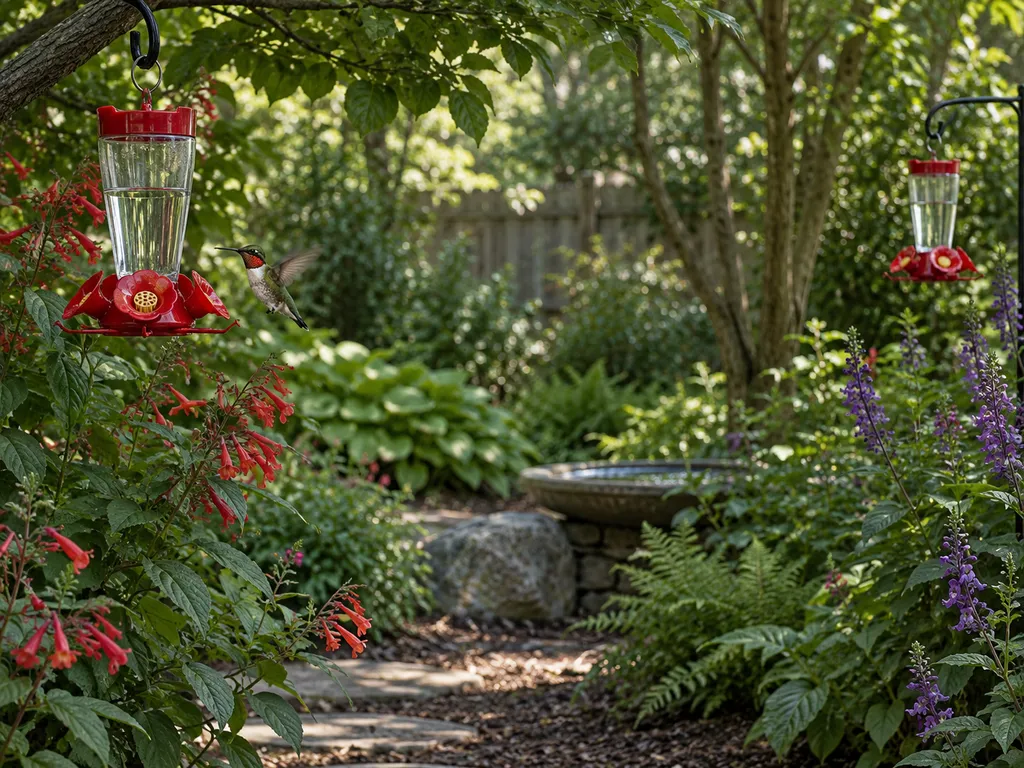
A feeder with many ports is not always better. Hummingbirds often defend concentrated food sources. All About Birds notes that several tiny feeders with one port each, set around the home, can serve more hummingbirds than one large feeder with many ports because the birds are territorial around feeding sites https://www.allaboutbirds.org/news/feeding-hummingbirds/. If one bird guards a feeder all day, adding another feeder out of sight may help more than buying a larger one.
Perches are a matter of preference and design. Some hummingbirds will perch while feeding; others hover. A small perch can make viewing easier and may let a bird conserve energy briefly, but oversized perches can also invite larger birds in some locations. If orioles or woodpeckers regularly empty a feeder and you want to keep the setup focused on hummingbirds, choose smaller ports and modest perches rather than a broad platform.
A Practical Buying Checklist
Before buying, imagine the dirtiest day of the season: warm weather, sticky ports and a feeder that needs cleaning before you leave for work. The right feeder is the one you will still clean well on that day. Use this checklist before the color, shape or decorative style wins you over.
- The feeder comes apart without tools.
- The reservoir opening fits a bottle brush or is shallow enough to wipe completely.
- Ports can be scrubbed with a small brush or pipe cleaner.
- The base seals tightly and has replaceable or durable gaskets.
- There are red parts to attract attention, but the nectar remains clear.
- The capacity matches your real visitor traffic and cleaning schedule.
- Any moat or bee guard can be cleaned, not just attached.
- The hanger keeps the feeder level and sheltered from strong wind.
Which Type Should You Choose?
For most beginners, choose a small red saucer feeder with a built-in ant moat, clear reservoir or visible fill line, and a top that removes fully. It is usually the easiest style to clean and the least fussy about leaks. If you prefer the classic look of a hanging bottle, choose a wide-mouth model with a sturdy base, simple ports and shade-friendly placement. If close viewing is the goal, a small window saucer feeder can work well as long as you clean it frequently and keep the glass area bird-safe.
Whichever feeder you choose, fill it with fresh 4:1 nectar, keep it clear, and skip red dye, honey, brown sugar, artificial sweeteners and additives. Audubon and extension guidance agree on the basic principle: a feeder is helpful only when it is kept clean, refilled with the proper sugar-water solution, and maintained often enough for the weather. The most beautiful feeder in the store is a poor choice if it cannot be taken apart and scrubbed.
The Bottom Line
Hummingbird feeder types are easier to compare when you sort them by function: saucer or bottle, glass or plastic, hanging or window-mounted, basic or pest-resistant. The best design for your yard is the one that stays level, avoids leaks, holds a realistic amount of nectar, discourages pests without unsafe substances, and cleans completely at every refill. Start small, keep it shaded and sheltered, and add additional feeders out of sight of one another if territorial birds dominate a single station.
The Bottom Line
A good hummingbird feeder is not defined by ornament or size. It is defined by whether you can keep it clean, fresh, stable and accessible to hummingbirds. Saucer feeders are often the easiest everyday choice, bottle feeders can work well when shaded and sealed, glass and plastic both have tradeoffs, and window feeders are best kept small and close to the glass. Choose simple parts, clear nectar, red feeder accents and a capacity you can maintain.
Frequently Asked Questions
What type of hummingbird feeder is easiest to clean?
A simple saucer feeder is often easiest because the reservoir is shallow and the top usually removes completely. Whatever style you choose, make sure the ports, base and reservoir can all be scrubbed at every refill.
Are saucer hummingbird feeders better than bottle feeders?
They are not always better, but they are often less prone to leaks and can be harder for insects to access. Bottle feeders can also work well if they have a wide mouth, tight base, simple ports and shaded, wind-protected placement.
Is glass or plastic better for a hummingbird feeder?
Both can work. Glass resists staining and feels sturdy, while plastic is lighter and common in saucer and window designs. Cleaning access matters more than material, so avoid any feeder with hidden seams or ports you cannot brush.
How large should a hummingbird feeder be?
Choose the smallest size that matches your visitor traffic. The feeder should hold only what birds can use before the next cleaning. For many yards, a 4- to 8-ounce feeder is more practical than a large reservoir that sits partly full for days.
Do hummingbird feeders need to be red?
The feeder can have red parts, but the nectar should remain clear. Red bases, caps or flower-shaped ports help attract attention; red dye or colored nectar is unnecessary.
Should I buy one large feeder or several small feeders?
Several small feeders can work better when one hummingbird guards a single feeder. Place them far enough apart, ideally out of sight of one another, so more birds have a chance to feed.
Sources
This guide was researched using these sources.
- https://www.allaboutbirds.org/news/feeding-hummingbirds
- https://www.audubon.org/magazine/hummingbird-feeding-faqs
- https://www.audubon.org/community-science/hummingbirds/how-create-hummingbird-friendly-yard
- https://www.allaboutbirds.org/news/where-to-put-your-bird-feeder
- https://feederwatch.org/learn/feeding-birds/how-to-clean-your-feeders
- https://www.audubon.org/magazine/how-keep-your-hummingbird-feeder-free-pests
- https://extension.missouri.edu/publications/g9419